I have decided that when someone asks me how I stand on "la question liturgique" - as opposed to just assuming, which I think many people do - I will say that, "I love liturgical tradition while I have trouble, at times, with self-identified 'traditional-ISTS.'" That is, I have problems with some of the personal attitudes and narrowness of vision, the frankly cultish tendencies of some who have chosen the Tridentine Mass as their banner. And frankly, I don't think some of them have anywhere near the appreciation for the very thing which they claim defines them. My yardstick is that, if I had to choose between a Tridentine Low Mass (esp. with only the server doing the responses) and a Novus Ordo Latin Mass celebrated ad orientem with incense, a complement of servers, chant, polyphony, etc., I would definitely choose the latter. The second follows the spirit of liturgical tradition far better. (I am not saying that you can't criticise specific prayers/features of the 1970 Missal. Neither am I saying that there weren't serious problems with the liturgical reform. I am just trying to make the basic point that the solemn sung Mass is the liturgical ideal.)
Of course, most people do not have these two things to choose between. Still, since I have been in this ideal situation I can get closer to the truth of the matter.
However, having criticized traditionalists, I will not let the neo-Catholics off the hook - or at least some of them who think that the Extraordinary usage will go away if they grit their teeth hard enough. What I say to them is, "as long as you insist on quarentining something, you are guaranteeing it will be associated with sick people." The whole point of Summorum Pontificum was to acknowledge that it is wrong to treat something considered holy for centuries as if it were all of the sudden bad - rather than what it should be, revered. You are undermining the Pope's intentions. The Extraordinary usage is a legitimate, normal liturgy of the Church - it belongs to ALL Catholics (not just Catholic's whose belts are tied a little too tightly) - so get to work and start forming 'ordinary' catholics in it.
Friday, August 29, 2008

Thursday, August 28, 2008
Beautifying the Ugly
In Walker Percy's first novel, The Moviegoer, the lead female character, who has psychological/emotional problems, utters a line like, "I wish I could have a nervous breakdown like those people in the movies." The point being, nervous breakdowns and other such things are not at all "aesthetic" experiences. They are painful and ugly, but in order to render them artistically they have to be in some way cleaned up, made more presentable. Yet, by doing so, they are falsified, at least to some degree. The solution of modern art/music/drama/etc. has been to develop a repertoire of truly ugly sounds, images, techniques which do more vividly portray these things. The reaction of the general public (at least it used to be) is to say, "well, that's not art." I used to be unsympathetic, but I think that they are correct in that it is certainly not classic Western art which insists on a certain level of beauty.
This is a subject that needs more exploration. Any ideas?
This is a subject that needs more exploration. Any ideas?
Wednesday, August 27, 2008
More on Listening to Music
I had discussed Theodor Adorno's "types of musical conduct" in regard to listening to music. It is very useful, but a bit more of a sociological analysis than some might want. I recently came across another, simpler, approach which sheds light on the way in which people listen to music in a book entitled "Thinking about Music" by Lewis Rowell. It is a very good summary. He discusses three ways of listening to music:
1) The first approach identified by Leonard Meyer as "associative listening." According to Meyer:
"Often music arouses affect through the mediation of conscious connotation or unconscious image processes. A sight, a sound or a fragrance evokes half-forgotten thoughts of persons, places, and experiences; stirs up dreams 'mixing memory with desire;' or awakens conscious connotations of referential things. These imaginings, whether conscious or unconscious, are the stimuli to which the affective response is really made. In short, music may give rise to images and trains of thought which, because of their relation to the inner life of the particular individual, may eventually culminate in affect."
This is basically Adorno's "emotional listener." Music is seen exclusively as a stimulus to reverie and affect. It is the least sophisticated approach to listening to music. I used to listen to music this way when I was a teenager.
The next two approaches were named by Edward Cone:
2) "Synoptic listening" is a name for what Adorno calls the "expert listener." "Synoptic" means "side by side," so it refers to the ability to hear individual moments and put them together "side by side" in the mind into a whole. It is another name for "structural hearing." This is something that requires a fair amount of training and experience.
3) "Immediate Apprehension" is [t]he mode by which we directly perceive the sensuous medium, its primitive elements, and their closest relationships." It is what most people are capable of - hearing a theme or melody. The relationship between immediate apprehension and synoptic listening is analogous to that between "experience and contemplation" according to Edward Cone.
So, to summarize, "immediate apprehension" combined with "synoptic listening" is the ideal, while "associative listening" alone is the least sophisticated.
1) The first approach identified by Leonard Meyer as "associative listening." According to Meyer:
"Often music arouses affect through the mediation of conscious connotation or unconscious image processes. A sight, a sound or a fragrance evokes half-forgotten thoughts of persons, places, and experiences; stirs up dreams 'mixing memory with desire;' or awakens conscious connotations of referential things. These imaginings, whether conscious or unconscious, are the stimuli to which the affective response is really made. In short, music may give rise to images and trains of thought which, because of their relation to the inner life of the particular individual, may eventually culminate in affect."
This is basically Adorno's "emotional listener." Music is seen exclusively as a stimulus to reverie and affect. It is the least sophisticated approach to listening to music. I used to listen to music this way when I was a teenager.
The next two approaches were named by Edward Cone:
2) "Synoptic listening" is a name for what Adorno calls the "expert listener." "Synoptic" means "side by side," so it refers to the ability to hear individual moments and put them together "side by side" in the mind into a whole. It is another name for "structural hearing." This is something that requires a fair amount of training and experience.
3) "Immediate Apprehension" is [t]he mode by which we directly perceive the sensuous medium, its primitive elements, and their closest relationships." It is what most people are capable of - hearing a theme or melody. The relationship between immediate apprehension and synoptic listening is analogous to that between "experience and contemplation" according to Edward Cone.
So, to summarize, "immediate apprehension" combined with "synoptic listening" is the ideal, while "associative listening" alone is the least sophisticated.
Tuesday, August 26, 2008
Topaz: More Bravura Moments
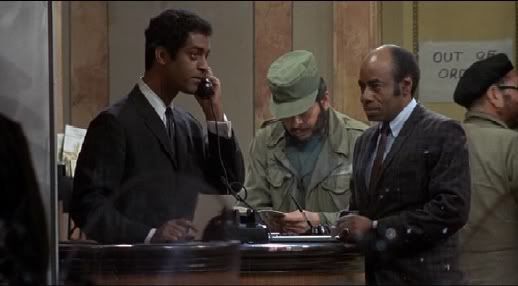 To continue with the theme from my previous post, there are two more scenes of some significance in which Hitchcock cuts out dialogue altogether - or at least our ability to hear it. Both involve the black actor Roscoe Lee Brown who is on our right in the picture. He had a very rich, baritone voice and had trained as a Shakespearean actor so he was often called upon to play a certain sort of urbane, upper class black man. (I remember him from television shows like "All in the Family" and "Sanford and Son" from the 70's when he was often used as a comic foil. Sadly he passed away last year at the age of 81.) Anyway, in Topaz he plays a florist shop owner in Harlem who originally is from the isle of Martinique. Remember, the movie takes place around the time of the Cuban missile crisis in October of 1962 and that shortly before that Castro and his delegation had been to New York for a session of the United Nations. In order to show their "solidarity" with the oppressed classes of 'capitalist America' they deliberately chose a hotel in Harlem. This black florist, however, works as a spy and is approached to try to infiltrate the hotel and take pictures of some important documents one of the Cuban officials has. These documents confirm that the Russians have sent missiles to Cuba - something which had been suspected.
The first scene is when a French agent, on behalf of the Americans, approaches this florist to do the job. Because the shop is open and people are all around, Roscoe Lee Brown takes the French agent into that glass enclosed refrigerated area that most all florist shops have (yes, ladies, I actually have been in a number of florist shops). So we see their conversation, all of the hand gestures and facial expressions, but don't hear a thing. We don't need to. We know basically what is being said. Is this a stylization - a bravura moment? Yes, I think so, but we are also forced to focus on the visual and let that reveal to us how the characters interact.
The second scene is when Roscoe Lee Brown goes to the Harlem hotel to bribe the Cuban official. They have information that he has accepted bribes in the past. The French agent watches from across the street and we become his eyes. We can see easily into the lobby of the hotel because it is completely glass enclosed. The Cuban official comes down into the lobby and we can see immediately that he is a morally weak man by the way he moves - hesitant and indecisive. The actor played his part very well with his body language. First he refuses, but we see Roscoe Lee Brown confidantly tap his breast pocket where the money is and the official agrees. Temptation - weakness - minor resistance - one more habitual failure of the will.
The fallen human condition. Excellent acting.
Anyway, I highly recommend the movie if you like spy thrillers. There are a few somewhat steamy romantic scenes, although not as bad as North by Northwest and nothing like what you would see in a movie today. It is second tier Hitchcock, but that still is quite good.
Monday, August 25, 2008
Topaz: An Example of What I Mean
 My preference for films which involve a skillful manipulation of visual imagery is exemplified in another one of Alfred Hitchcock's movies, Topaz. Topaz was released in 1969 and was based on a Leon Uris novel of the same name about the Cuban Missle crisis. The picture I have included is the famous one of the beautiful Cuban spy who is shot and whose dress unfurls as she falls. (This still is from the very end of her fall so, of course, it does not convey what I am talking about very well. Frankly no 'still' would convey it.) It is a memorable scene which virtually every movie reviewer points out. It is, in a sense, like a flower opening (she is beautiful in life, beautiful in death), however, more obviously, it is a stylization of a pool of blood forming. It is quintessential Hitchcock in that he is working within the confines of the structure of the "American movie" of the time but includes moments of European 'artsiness' (Kind of like Haydn and Mozart using the sometimes overly cutesy and transient 'style galant' material of the time, but doing things with it that transcend the genre?) Leonard Maltin called this a "bravura moment" - "it's artistic, poetic, flamboyant, yet it works . . . it is the work of a master."
 I agree.
However, what I really want to speak about is the opening sequence - the first ten minutes. There is virtually no dialogue. The only speaking is: 1) a tour guide speaking at the figurine factory (this is PURE background), 2) the Russian father asking for directions to the figurine factory (very unimportant), 3) the Russian teenage daughter phoning the American Embassy from the figurine factory office to ask where they should be to be picked up when they defect (more important - but not as much as it may seem). The whole focus is on the Russian family evading the KGB agents, first at the figurine factory, and then outside the department store. Two sounds, however, are important. The first is the dropping of the porcelain figurine by the daughter so she will be taken to the office (outside of the view of the KGB agent) from where she makes the brief phone call. It is preceded by 30 seconds of almost total silence and I cannot stress how much this is a climax. The second is at the very end of the sequence when they finally escape in the car with the Americans. The daughter cries in her mother's arms partly out of physical pain (she had run into a bicycler while they were escaping and had fallen, painfully scraping her knees), partly out of emotional anguish (the whole painful ordeal of the defection seems to be finally over.)
So two sounds - the sound of porcelain breaking and the sound of a girl crying - are key to the first ten minutes. Everything is conveyed by the visuals and by these sounds. Dialogue is unimportant.
There are two other scenes in which there is a total 'black out' of the dialogue in this movie (a black out of the original scripted dialogue, I believe) - more stylized "bravura moments" which I shall blog on later.
Friday, August 22, 2008
It Doesn't Translate
I recalled from my European trip a brief exchange I had with one of the Hungarians that was amusing. I should preface this by saying that in German when you say, "Danke schoen," the other person replies, "Bitte schoen." Sometimes you just say, "Danke," and they say, "Bitte." A few times I heard someone say, "Danke" and the reply was, "Schoen." It doesn't make sense in English, but that is what they say sometimes. One of the Hungarians, who spoke German well but not English very well, was offering everyone a piece of some candy she had bought. When I said, "Thank you," in English she replied in English, "pretty!"
Thursday, August 21, 2008
Maritain: Art and Scholasticism
 I just picked up the book and found a very moving passage:
"The Middle Ages knew this order. The Renaissance shattered it. After three centuries of infidelity, prodigal Art aspired to become the ultimate end of man, his Bread and his Wine, the consubstantial mirror of beatific Beauty. . . And now the modern world, which had promised the artist everything, soon will scarcely leave him even the bare means of subsistence. Founded on the two unnatural principles of the fecundity of money and the finality of the useful, multiplying needs and servitude without the possibility of there ever being a limit, destroying the leisure of the soul, withdrawing the material factible from the control which proportioned it to the ends of the human being, and imposing on man the panting of the machine and the accelerated movement of matter, the system of "nothing but the earth" is imprinting on human activity a truly inhumane mode and a diabolical direction, for the final end of all this frenzy is to prevent man from resembling God,
dum nil perenne cogitat,
seseque culpis illigat.
Consequently he must, if he is to be logical, treat as useless, and therefore as rejected, all that by any grounds bears the mark of the spirit.
Or it will even be necessary that heroism, truth, virtue, beauty become useful values - the best, the most loyal instruments of propaganda and of control of temporal powers.
Persecuted like the wise man and almost like the saint, the artist will perhaps recognize his brothers at last and discover his true vocation again: for in a way he is not of this world, being, from the moment that he works for beauty, on the path which leads upright souls to God and manifests to them the invisible things by the visible."
---------------------------------
I detect a certain approach to history which is very consonant with the views of our Distributist brethren. I am not saying that I disagree or agree, only that I find the passage very passionate and moving. I think it is worth some reflection and comment.
Subscribe to:
Posts (Atom)