Tuesday, July 15, 2008

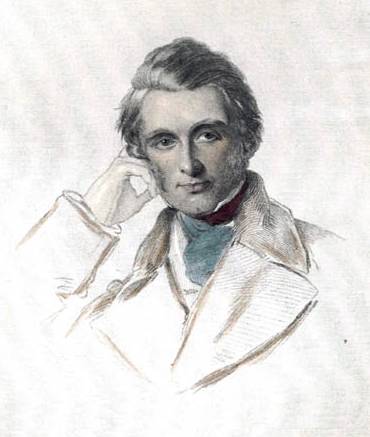
John Ruskin - 19th Century Art and the Middle Class


Here are Eight points which could sum up John Ruskin's View on Art as formulated by the art historian Kenneth Clark:

1.Art is not a matter of taste, but involves the whole man. Whether in making or perceiving a work of art, we bring to bear on it feeling, intellect, morals, knowledge, memory, and every other human capacity, all focused in a flash on a single point. Aesthetic man is a concept as false and dehumanizing as economic man.

2.Even the most superior mind and the most powerful imagination must found itself on facts, which must be recognized for what they are. The imagination will often reshape them in a way which the prosaic mind cannot understand; but this recreation will be based on facts, not on formulas or illusions.

3.These facts must be perceived by the senses, or felt; not learnt.

4.The greatest artists and schools of art have believed it their duty to impart vital truths, not only about the facts of vision, but about religion and the conduct of life.

5.Beauty of form is revealed in organisms which have developed perfectly according to their laws of growth, and so give, in his own words, 'the appearance of felicitous fulfillment of function.'

6.This fulfillment of function depends on all parts of an organism cohering and cooperating. This was what he called the 'Law of Help,' one of Ruskin's fundamental beliefs, extending from nature and art to society.

7.Good art is done with enjoyment. The artist must feel that, within certain reasonable limits, he is free, that he is wanted by society, and that the ideas he is asked to express are true and important.

8.Great art is the expression of epochs where people are united by a common faith and a common purpose, accept their laws, believe in their leaders, and take a serious view of human destiny.

Ruskin's criticism of the art and architecture of his time seems to have had to do with what he saw as its connection with the Industrial Revolution and, to some degree, the middle class and laissez-faire capitalism. My friend's criticism of artists such as Degas and Renoir (in the posts below) seems to make a connection between individualist innovation, the middle classes, and modern capitalism, but Ruskin seemed to be of the view that modern times were less fortuitous for the individual - praising the "crude and 'savage' aspects of Gothic stonework as proof of 'the liberty of every workman who struck the stone; a freedom of thought, and rank in scale of being, such as no laws, no charters, no charities can secure. Classical architecture, in contrast, expressed a morally vacuous repressive standardisation. Ruskin associated Classical values with modern developments, in particular with demoralising consequences of the industrial revolution."

The connection is between middle class (and mass markets) and standardization; not middle class/mass markets and liberty or individualism. In fact the more liberal musicians of the 19th century were reacting AGAINST the middle class ticket buyers whom they felt stifled their freedom. Think of Schumann's 'Davidsbundler' (League of David) which was to slay the 'Philistines.' (i.e. the general public). This is from whence the term 'philistine' acquires the connotation "uncultured."

And this is ultimately where the tradition of the symphony concert involving pretty exclusively "old masters" comes from. In the Baroque era, for example, Bach was constantly writing new music - not because he was a Bohemian looking constantly to innovate, but because, well . . . his patrons expected it.

As Kerman has noted, "[w]hile many aristocratic patrons cared less about music than display, and some excercised the most whimsical tastes, others actually encouraged composers to pursue new paths, or at least left them alone to do so . . . [t]he mainly middle-class [i.e. nineteenth century] buyers of concert tickets naturally wanted value, as with anything else they bought. What counted as value was something already established as a masterpiece, something that they already knew and liked."

In other words, a mass market may find it fortuitous to promote "individualism" for its own end. (i.e. "Be a rebel, just like James Dean. Buy this exclusively made James Dean leather jacket, etc") However, by its very nature, a mass market tends toward conformity - perhaps a set of options, but a set that fits within a simple enough grid. ("Hold the pickle, hold the lettuce, special orders don't upset us," etc.) Rather shameless appeals to the individual ("L'Oreal - because you're worth it." "You deserve a break today." "Unleash the beauty that is you.") are meant simply to persuade more people to by a product - but honestly, I don't see a true connection between this and the individualism of 19th (and 20th) century liberal artists looking to innovate. Even if we may find them misguided at times-some of them very misguided esp in the 20th century. They would have found this just as abhorent.

Let's be fair.

In a sense, both liberals and conservatives were reacting AGAINST the middle class, industrialization, and lasissez-faire capitalism of the 19th century, but in different ways. Yes, liberal individualists were ultimately wrong as regards Ruskin's points #6 and #8, but humanly speaking, what were they to do? Society had broken down, the great systems of social support and patronage (the aristocracy and the clergy) were gone or severely reduced - THEY (liberal artists) didn't have the faith. What were they to do? They didn't create the system in which they were living. They pursued a path of individual innovation and aestheticism, which, frankly, in some cases produced some very striking art works.

I am sorry but I just cannot look at Degas or Renoir and see them as the forefathers of Wal Mart. (and let's not forget that Warhol, whom I am not a big fan of, nonetheless had as his point not the glorification, but the questioning of the very concept of the unique artwork of the INDIVIDUAL; and the deliberate banalization of the mass produced objects of a modern society: from brillo pads to movie stars).

My main point here is that people and ideas (no matter how bad or good they may be per se) are being lumped together with the assumption that they are sympatico or even in a cause-effect relationship. I am disputing this.

My second point is that when I look at Renoir's "Umbrellas," for instance, my reaction is, "that's beautiful," not "would this really exist in an ideal, fully Catholic culture." I am not sure that this is what a Distributist/Traddie would say, but I fear that is what some may be thinking. To my mind, all beauty comes from and leads back to God - although, I will fully admit that people can get stuck on beauty and turn it into an idol on the purely natural level. Though this need not be so. Lot's of food for thought.

OK class, let's discuss.

The Lady of Shalott


Here is another painting, this one by John William Waterhouse (1849-1917), based on Tennyson's poem of the same name. Waterhouse was not a part of the pre-Raphaelite Brotherhood, but was influenced by them. (You need to double click on this one as well to see a nice big version of it.) You can also see a similarity in theme between this painting and 'Ophelia' below: a lonely young woman and the water. The distraught, almost suicidal look reminds me of a soprano after she's had a bad voice lesson. Yep, I would know that look anywhere.

Monday, July 14, 2008

Sir John Everett Millais of the Pre-Raphaelite Brotherhood


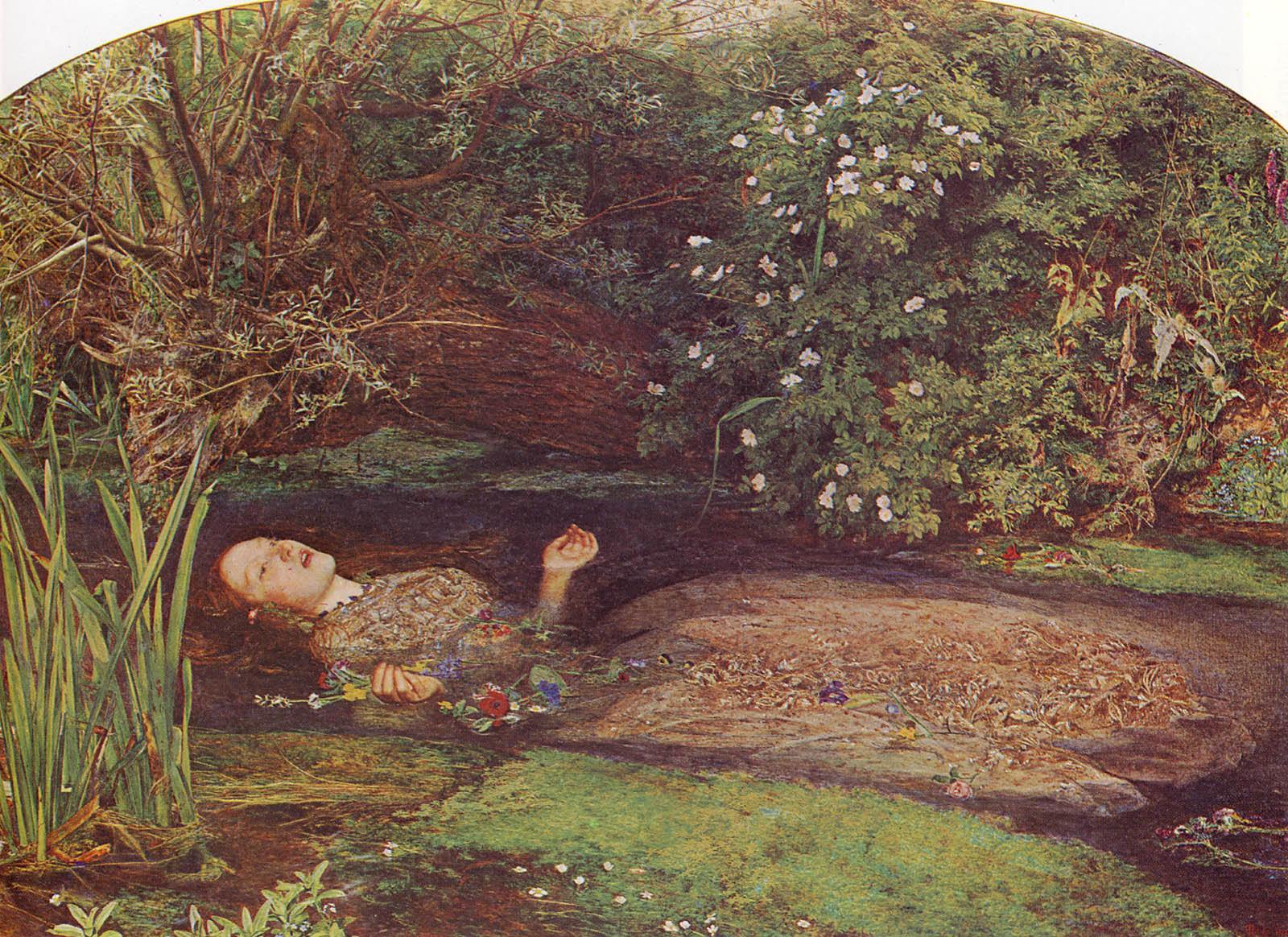
Speaking of the Pre-Raphaelites, here is the 1852 painting "Ophelia" by one of its members Sir John Everett Millais. In this picture he creates "dense and elaborate pictorial surfaces based on the integration of naturalistic surfaces." A kind of "pictorial eco-system." This approach was promoted by Ruskin. It's too small to get a good impression, so double click on it to get the full size picture with all the detail. I don't know about you, but for some reason, looking at the woman, it makes me think, "This is so typical of something a soprano would like to do."

Frauenlob - The Ladies' Man


Mild-mannered Heinrich von Meissen occasionally experiences a change coming over him. "I don't know what happens to me, but I start to feel different. My clothes change, my face changes. I start referring to myself as 'Frauenlob,' and it is as if I am living in 1977 instead of the 13th century." He says he hopes it is only a bad dream, but has distinct memories of holding something called a "microphone" (whatever that is) and using phrases like, "I would like to dedicate this next song to all of the special ladies in the audience" and (even worse) "are those your eyes, or have the stars come out early tonight?!" Is this a Dr. Jekyll/Mr. Hyde situation spanning the centuries? Or has there always been a little bit of 1977 in the back of everyone's consciousness? Or is Heinrich just so bad with women that he figures, "What the heck, I have nothing to lose."

Take Dr. Poterack's Music History class this Fall semester and find out.
----------------
I know this is terrible, but I wanted to test my ability to post two pictures in one post AND amuse at least part of my audience. If you don't get the joke, go to my July 13th post entitled "Famous Composers and Artists."

Mr. Neutron, London's West End, and Westminster Abbey


Does anyone remember the Monty Python episode where Mr. Neutron - the strange super hero with his 'child bride' Mrs. S.C.U.M. - says, "I like this area. It's handy to the shops and convenient to the West End"? Well, I didn't know what he was talking about until I did some research. Greater London is a much bigger place than the original city. That is not difficult to understand as most cities grow. However, many important landmarks which we often think of as so obviously a part of London are not actually in "The City" but in the West End - what used to be the City of Westminster. Westminster Abbey, (the much newer - 1903) Catholic Westminster Cathderal, the Houses of Parliament, even Big Ben are in the West End. Hyde Park and Buckingham Palace are also in the West End. Such landmarks as London Bridge, The Tower, and St. Paul's cathedral are in "The City."

As you can see in the map above (c. 1300 AD), this is basically the city of London. The only bridge going across the Thames River at that time was "London Bridge" (which was evidently not falling down). Everything to the west would be Westminster (or the "West End" today). Notice the structure at the very bottom of the left hand side of the picture, where the Thames River goes North-South. That is Westminster Abbey which of course would have been there in 1300.

A little from Wikipedia on Westminster Abbey:

"In the 960s or early 970s Saint Dunstan, assisted by King Edgar, planted a community of Benedictine monks here. The stone Abbey was built around 1045–1050 by King Edward the Confessor and was later rebuilt again by Henry III in 1245, who had selected the site for his burial . . . Henry VIII had assumed direct royal control in 1539 and granted the Abbey cathedral status by charter in 1540, simultaneously issuing letters patent establishing the Diocese of Westminster. By granting the Abbey cathedral status Henry VIII gained an excuse to spare it from the destruction or dissolution which he inflicted on most English abbeys during this period. Westminster was a cathedral only until 1550. The expression "robbing Peter to pay Paul" may arise from this period when money meant for the Abbey, which was dedicated to St Peter, was diverted to the treasury of St Paul's Cathedral.

The Abbey was restored to the Benedictines under the Catholic Queen Mary, but they were again ejected under Queen Elizabeth I in 1559. In 1579, Elizabeth re-established Westminster as a "Royal Peculiar" — a church responsible directly to the sovereign, rather than to a diocesan bishop — and made it the Collegiate Church of St Peter, (that is a church with an attached chapter of canons, headed by a dean)."

Since 1066 Westminster has been the coronation site for most of the English monarchs. It today has a splendid choir of men and boys under the direction of James O'Donnell. I shall try to visit to experience them singing at Evensong on either Saturday July 19th or Monday July 21st.

Sunday, July 13, 2008

More on Famous Composers and Artists

My Friend Writes More:

"It is not the financial support, or the "commercialization" of art. What I wonder is to what degree we've been duped by a bourgeouis inheritance that is alien to an authentic Catholic perspective of art and the role of the artist. OK, so my kid can identify a Renoir and a Rembrandt. So what. That act values two ideals: the artist as an individual, and the work of art as an individual piece of creativity. And I wonder if these two values are true, or manifestations of modernism. To look at the Bayeux Tapestry, or Chartres, neither of these values are present. I suspect that "Look Mommy, It's a Renoir" is the child of modernism in this way: it glorifies the radically individual creative person performing a radically individualized act of creativity. So that's the wonder.

Of course, it needn't be said (so I'll type it instead) that Renoir, and Rembrandt and Beethoven created astonishingly beautiful things. That stands on its own. I have noticed that those in the know don't permit the questioning of so-called creative genius. We have sanctified the individual act of art, and the individual artist. It all must remain above questioning.

So, as with economics, a "distributist" or Traddy, or whatever you want to call someone who sees modern life for what it is, has to wonder if Warhol is the child of Renoir, and if truer art might involve a guild.

When Whistler was alive, he sued Ruskin for Ruskin's public derision of his paintings. I trust Ruskin, and I think he more clearly saw the radical turns in art as it was fresh on the scene."

--------------

Much here worthy of discussion and exploration. I think our current culture is in many ways a sinkhole but I still say, "CAREFUL." I have seen many erstwhile conservative and/or Catholic cultural commentators point to a 'trend' in modern life that may indeed be harmful, or less than ideal. Then they jump to pointing out how a particular artist was influenced by such a trend, and then jump to the conclusion that everything he created therefore must be 'disordered' and should be shunned - WITHOUT EVEN LOOKING AT THE WORK OF ART ITSELF. This is a cautionary note I wish to get out of the way. (I know you ackowledged it above, but I think it bears repeating.) Even God has chosen to work with a fallen creation and our own weak wills so that he can bring good out of evil. I mean, one has to be careful about this but, think about the whole "felix culpa" business of the Exsultet. The background of original sin was the "canvas" for the artwork of Redemption. The problem I have with some of the distributist/Traddy schemes is that they strike me as almost socialist - the creation of an ideal society based on the past (or usually someone's debatable reconstruction of aspects of the past) rather than the future (as with socialism). In both cases what isn't taken into account is man's fallen nature AND his ability to transcend his surroundings.

Nay, to even use parts of his surroundings to a good end.

That being said, to anyone who wishes to start a discussion along the lines of Ruskin and the Pre-Raphaelites I say, "Great, go to it." I just haven't seen anything rise even to that level in the circles we travel in because these are not actual artists - and, yes, it would be good to consult such people who know intimately about art. At least all I have seen have been historian/social critic types in love with ideas and theories, but with limited musical/artistic culture, and 'concerned parents' who understandably don't want junior's morals corrupted.

The results would be comical if not sad. Said 'concerned parents' decide junior should only listen to Gregorian chant. It might work with some personality types, but with others they end up with a CD collection made up of half Gregorian Chant and half Heavy Metal (but nothing in between). One particular institution teaches the theory that modern popular music is an abomination (which it indeed can be) and that the ideal society should have 'art music' and 'folk music.' A theory that is very German, therefore, interesting and, I think, from the neo-Marxist Frankfurt School (which I don't think this institution is aware of as they got it through the intermediary of John Senior). Still, all-in-all, an interesting idea. Problem is it gets bastardized into, "you should only listen to Gregorian Chant and Irish folk music." At least by the time it gets to the students. I here of a student of said institution who would go out jogging with his iPod so he could secretly indulge in the 'sinful pleasure' of listening to Schubert's Ave Maria.

It may be a false story, but there is a grain of truth in it. Don't get me wrong. I think many people listen to atrocious crap and their lives would be immensely improved if they listened to Gregorian Chant and Irish folk music. They don't have a clue. However, the "conservative Catholic" reaction goes too far. It is not really Catholic, but Puritanical.

It is not CULTURED, therefore it is not Catholic.

It is ideology masquerading as informed opinion about music. There is no getting around it. Teach people about good music and art (give them that as part of their regular diet) no matter what soil it grew in, and there will be a chance.

I just wanted to get that rant out of the way. Now we can talk about Ruskin and the Medieval Guilds - at least after I do one post about Mr. Neutron and London's West End. (It's getting late.)

Famous Composers and Artists

A Good Friend of Mine Asks This Question:

"I began wondering why its important to "know" Beethoven and Degas, and what it means that a culture elevates A Musician or A Painter, when that was not necessarily the case before. Anyway, at root I'm trying to apply my suspicions about capitalism to other manifestations of our culture since the fall of the European Catholic culture after the 13th century."

My first advice is: get to know these men and their works inside and out. They were great artists in their respective fields, so that should be reason enough. Even if you still dislike what they did, they did it well so "give the devil his due." The second thing I would point out is that much of the early artistic work in Western Civilization was not only religious but liturgical. There is a long tradition of artistic anonymity when it comes to such things. It just never would have occurred to the composer of the Introit for the 8th Sunday after Pentecost to inscribe it, "composed by Johannes Planctus, for my parents." They just didn't think that way. There are, however, traditions that have grains of truth of varing size, ascribing even liturgical music to some individuals: St. Gregory the Great (Gregorian Chant), St. Ambrose has hymns ascribed to him, then there is Romanos the Melodist in the East. By the 12th century you have the polyphony of Leonin and Perotin of the Notre Dame School of composition - although they don't sign their works, it is the eager English undergraduate, 'Anonymous 4,' who writes about them. (They had their following amongst their contemporaries - or at least their student admirers. "Aren't Leonin and Perotin cool, the cat's pajamas, rad, etc.")

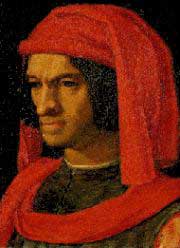
We can continue, of course after the 13th century, but in fully Catholic cultures there are known famous liturgical composers such as Josquin des Prez, Victoria, Palestrina, William Byrd, etc. Then of course before that there were the secular Medieval troubadours, trouveres, and minnesingers - all known by name and this was 12th-13th centuries. My favorite is the German Minnesinger known as "Frauenlob" (his real name was Heinrich von Meissen) which means "praise of ladies." Actually I think this was tied into courtly love (with Marian overtones), but the name makes me laugh because it conjures up an image of an early day wearer of leisure suits who goes to singles bars in order to 'praise ladies.' "But you have such beautiful eyes." "Yeah buddy, I've heard that line before. Move along."

Frauenlob, the 13th century ladies man.

Anyway, my point is this. Though certainly there is an intensification of "great individuals" at about the time of Beethoven and this can be tied into capitalism in some ways, Western culture had these tendencies from early on. Once you get away from purely ritual music and folk music (both performer based) even though there may be 'traditions ascribing a melody to someone' - remember outside the West this is what 'music' is, it is something that 'performers do' with communally owned 'found objects' known as melodies, ragas, etc. - once you give major control of music to an individual known as a 'composer' ("no you must play this chord in measure 9." "Why? because I am the composer and 'wrote' it that way." Exacting music notation is another Western invention) then the jig is up. There will be a focus on various great individuals who created the music in exacting detail all by their lonesome.

Composers. A unique phenomenon that emerges in the West long before Industrial capitalism and really about the beginning of the Second Millenium.

Those are my off the cuff thoughts. What do you think?