 Wednesday, Nov. 12 Susan Duer will play an all Beethoven 'fortepiano' recital in the Chapel Crypt at 8 PM. I even forget that Beethoven's piano - though it was evolving - was still much closer to the wood-framed tinkly little Mozart type of an instrument than the modern piano.
Monday, November 10, 2008
Concert - Wednesday Evening
Wednesday, Nov. 12 Susan Duer will play an all Beethoven 'fortepiano' recital in the Chapel Crypt at 8 PM. I even forget that Beethoven's piano - though it was evolving - was still much closer to the wood-framed tinkly little Mozart type of an instrument than the modern piano.

J.S. Bach (Part I)
 J.S. Bach
(excerpts from the book, Bach, Beethoven and the Boys by David Barber)
Just about everybody in the Bach family was a good musician, but nobody was better than Johann Sebastian. If you wanted to you could trace the Bach family back through five generations. But you still wouldn't find anybody to bear J.S. Various members of the Bach clan were organists, town pipers and instrumentalists in Thuringia, a small state in the eastern part of what is now Germany. As far as being musicians, the Bachs had Thuringia pretty much sewn up.
Johann Sebastian's great-great-grandfather, old Veit Bach, was a miller. He liked to play his lute while the millstones ground flour in the background. J.S. later said it probably helped him to keep time. Johann Sebastian's father, Johann Ambrosius, married Elizabeth Lammerhirt, whose family were prosperous furriers and part-time mystics.
Johann Ambrosius had a twin brother named Johann Christopher. They looked so much alike that not even their wives could tell them apart. Johann Ambrosius and Elizabeth had three sons: Johann Christoph, Johann Jakob, and Johann Sebastian.
Johann Sebastian was born on March 21, 1685 and baptized two days later at the little church of St. George in Eisenach. At last report, the church still stands, and the present pastor still refers to that historic event whenever he baptizes a new little baby in the same font. Maybe he figures it will give them something to work towards.
At age eight, little Sebastian was sent of to school, where he did considerably better than his brother Johann Jakob. He was a good singer and was one of those pupils who always knows the answers to everything.
His mother died when he was nine and his father a year later, so Sebastian was shipped off to the little town of Ohrdruf to live with his brother Johann Christoph, who was an organist and a pupil of Johann Pachelbel -- the one who wrote the famous Canon. Since money was scarce it was soon decided to send little Sebastian to the choir school of St. Michael in Luneberg. The rules stated that the singers had to be the "offspring of poor people, with nothing to live on, but possessing good voices." He seemed to qualify on all counts, so off he went.
The school paid for his tuition, room and board, and gave him candles and firewood. When his voice broke, we are told, Sebastian sang and spoke in octaves for a week. It must have been an interesting effect, but it didn't last. Anyway, Sebastian was kept busy after that playing violin, viola, and organ.
One of the ways Bach learned about music was to copy the compositions of his predecessors. He did a lot of this while at school. Historian Cecil Gray says: "He absorbed all styles, instead of being absorbed by them." Karl Geiringer says something similar: "Young Sebastian absorbed all instruction as readily as a sponge does water."
For a while, Bach studied organ in Luneburg with Georg Bohm, who had been a pupil of a man named J.A. Reinken. Bach walked 30 miles to Hamburg to hear Reinken play. After arriving in Hamburg, Bach was hungry and tired from his long walk, but had no money for a meal. As he tells the story, he was just sitting outside an inn minding his own business, thinking about food and rubbing his tired feet, when out from an open window were tossed two herring heads. And as if that weren't enough, each fish head contained a Danish ducat.
(to be continued)
Friday, November 7, 2008
PALESTRINA (Part II)
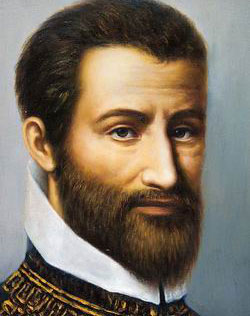 PALESTRINA
(excerpts from the book, Bach, Beethoven and the Boys by David Barber)
Palestrina went into partnership with the shop's young apprentice and together they made a killing on the market. Palestrina's wife was no fool, either. She invested 500 scudi into the business, which she later withdrew and lent back to Palestrina at eight-per-cent interest. He owned four houses, which he rented out to quiet tenants.
Palestrina was very busy. In the mornings he minded the fur store and unplugged his tenants' toilets; in the afternoons he composed motets and masses. Somehow he found time to write 93 Masses and 500 Motets, not to mention the four books of madrigals and other assorted church music.
But this is nothing compared to the vast number of works -- nearly 2000 -- composed by Palestrina's contemporary, Orlando di Lasso. He was born in Belgium in 1530 or so and had such a fine voice as a boy that he was kidnapped three times by rival choirs.
Lasso did very well for himself, always managing to get hired by rich patrons who let him travel all over Europe in grand style. Once when the church authorities organized a solemn procession through the streets of Munich the parade was nearly ruined when it looked like it was going to rain. As soon as the choir began to sing a piece of his music, the clouds parted and the sun shone. Thereafter, the same piece was sung at all processions, just to be on the safe side.
Lasso enjoyed tremendous popularity as a composer and had his music performed in all the best places. Although he was quite wild as a young man, he got more serious as he grew older. Towards the end he went bonkers. He no longer recognized his wife and started to mumble.
For all-round piety it's hard to beat Tomas Luis de Victoria, who was a Spanish composer of the same period. He was also a priest. He kept saying that he was going to give up composing and devote himself to the contemplation of higher things. But somehow he never quite got around to it.
Victoria studied in Rome before returning to Spain and admired Palestrina so much that he even took to copying his style of clothing and the way he trimmed his beard.
Victoria wasn't the only one who admired Palestrina, who even in his own time was better respected than most musicians ever manage today. Just two years before Palestrina's death, a group of composers got together and printed some music, which they dedicated to Palestrina, whom they called: "an ocean of musical knowledge." They said that compared to him they were merely, "rivers whose life is bound up with the sea." Palestrina was flattered, but had to ask them to stop before his feet got too wet.
Palestrina died in 1594 and was buried in the St. Peter's cemetery. Over the years, what with all the renovations and everything, we seem to have misplaced his grave. But he's still there somewhere, decomposing.
Thursday, November 6, 2008
PALESTRINA (Part I)
 PALESTRINA
(excerpts from the book, Bach, Beethoven and the Boys by David Barber)
He was born around 1525 to Santo and his wife Palme Pierluigi, in a little house in the Via Cecconi in the tiny village of Palestrina, outside Rome. When his paternal grandmother died she left him a mattress and some kitchen utensils. But since he was only two years old at the time they wouldn't have been much use to him.
Gianetto (as he was called then) was a happy, playful child who became an altar boy and sang in the local choir. When he was twelve he went to Rome to a choir school, where he was taught elementary composition and how to make spitballs. When he was 20 he got his first job as an organist back in his hometown. He married a girl named Lucrezia Gori, whose father had just died and left her some money (she also inherited a house, a vineyard, some meadows and a chestnut-colored donkey). Not long after, Giovanni Maria del Monte, the bishop of Palestrina, became Pope Julius III and moved to Rome. Julius showed his appreciation of local talent by appointing Palestrina director of St. Peter's choir. For this he was paid six scudi every month. This would mean more if we knew how much a scudo was worth, but we don't. Palestrina was later made a singer in that pontifical choir, even though he didn't have a very good voice (he was a tenor). His pay went up to ten scudi a month.
Julius died in 1555 and was replaced by Pope Marcellus II, who reigned for a grand total of three weeks. He died suddenly when he ate something that didn't agree with him. Marcellus II would hardly be worth mentioning except that Palestrina dedicated his Missa Papae Marcelli to him, thereby single-handedly saving the future of music forever. Well, that's what his biographer Giuseppe Baini says, and who are we to disagree with him?
It seems that church music at the time had gotten a little too racy and the new pope, Paul IV, called for it to be cleaned up. Composers had been using bawdy songs as the basis for their church music. Worst of all, no one could understand the words.
The story goes that some of the stuffier cardinals wanted to abolish polyphony altogether and get back to the basics with Gregorian chant. Palestrina showed that some of this music could be quite respectable. Evidently the cardinals fell for it.
Palestrina was by no means your typical artsy, head-in-the-clouds musician. He was a pretty shrewd businessman who sold barrels of sacramental wine to the church to make extra money. He wasn't very good at saving, though. When his son Angelo died suddenly, Palestrina had to borrow money to repay the bride's dowry, which he'd already spent.
Wednesday, November 5, 2008
HAYDN (Part III)
 HAYDN
HAYDN(excerpts from the book, Bach, Beethoven and the Boys by David Barber)
Through his connection with Porpora, Haydn soon got a job as a composer to the court of Count Morzin, a Bohemian nobleman. From there he was offered the job he stayed at for the rest of his life, as court composer and Kapellmeister to Prince Paul Anton Esterhazy, a Hungarian nobleman.
Paul Anton didn't last long and was soon replaced by his brother, Nicolaus the Magnificent. Nicolaus was a kind man and a decent musician, even if he did have a penchant for flashy clothing. Haydn's own uniform was blue with gold trim. Later it was red with gold trim.
Nicolaus liked to play an instrument called the baryton, which is a sort of cross between the cello and a guitar. Nobody makes them anymore. But if you wanted to learn it, Haydn wrote about 160 chamber pieces for the baryton, which ought to keep you busy for awhile.
Not content with the family palace at Eisenstadt, Nicolaus decided to build a splendid new castle, which he named Esterhaza. He had it built in a swamp in the middle of nowhere because he was fond of duck hunting.
Esterhaza was a classy place, but Haydn and his musicians didn't like being stuck in the boondocks, so far away form Vienna, not to mention their wives and children. The quarters were mostly single rooms. Haydn had one of the few apartments with room for his wife, not that he spent anymore time with her than he had to.
This situation led Haydn to compose one of his best-known symphonies, No. 45 in F-sharp minor, known as the "Farewell" Symphony. The joke comes at the end of the final movement when as the instrumental parts drop away, each player was instructed to snuff out his candle and leave the stage. By the end there were only two violins playing, Haydn and Luigi Tomasini. Nicolaus got the message and everyone packed to leave the next day.
Haydn's compositions have more nicknames than those of any other composer in the history of music. When you consider that he wrote, for example, at least 22 symphonies in D major, the nicknames become useful. Altogether, he wrote about 107 symphonies, a dozen Masses, 52 piano sonatas and about 84 string quartets. He had to have something to keep him out of the house at nights.
Even though his marriage was a disaster, Haydn had plenty else to be happy about. He was well respected by his contemporaries, including Mozart and Beethoven, who both studied with him. The members of his orchestra called him "Papa." He had stubby legs and a big nose and a mischievous sense of humor.
When Haydn died in 1809, there was a simple funeral, since Austria was rather busy being invaded by Napoleon's troops.
Tuesday, November 4, 2008
HAYDN (Part II)
HAYDN(excerpts from the book, Bach, Beethoven and the Boys by David Barber)
For the next few years, Haydn lived a gypsy life as one of the many street musicians, or buskers, in the city of Vienna. He made a little extra money giving music lessons , just enough to pay the rent at his tiny garret on the Michalerplaz. Late at night he studied the keyboard works of C.P.E. Bach and composed his own music.
His first big break came when he and some fellow buskers serenaded the house of Johann Joseph Kurz, a comedian and pantomime performer popularly known as Kurz-Bernardon, after his most famous role. Bernardon is a stock comic character, a simpleton also known as Hanswurst. Kurz commissioned Haydn to compose the music for a comic opera, Der Krumme Teufel (The Crooked Devil). Haydn got paid 25 ducats, which made him feel very rich.
After that, things started looking up for Haydn. The court poet Metastasio lived in a nicer apartment in the same building and through him Haydn met Niccolo Porpora, a famous singing teacher and composer. Haydn became his accompanist and valet. From Porpora he learned not only fundamentals of composition but also how to polish boots and keep the lint off a velvet jacket.
It was about this time that Haydn fell madly in love with one of his pupils, a lovely young woman named Therese Keller, a wig maker's daughter. Haydn wanted to marry her, but she decided she wanted to become a nun instead. When she entered the convent in 1756 Haydn composed a little organ concerto for the ceremony, just to show that there were no hard feelings.
As a sort of consolation prize, Therese's father suggested that Haydn could marry her older sister, Anna Maria. She was 31, he was 28. Too upset to think straight, he said yes. He lived to regret it: Anna Maria was ugly, ill-tempered, and a bad housekeeper. She had no appreciation of Haydn's life as a musician. She didn't care whether he was a cobbler or a composer. She would use his manuscripts to line cake tins, or cut the paper into strips to curl her hair with.
(to be continued . . .)
Monday, November 3, 2008
HAYDN (Part I)
HAYDN(excerpts from the book, Bach, Beethoven and the Boys by David Barber)
Haydn had neither the flashy individuality of Mozart nor the brooding, romantic passion of Beethoven. He was more of a middle-management type.
Haydn did spend a few years struggling to make ends meet as a young man in Vienna. But he spent most of his life -- nearly 50 years -- at the same job, which offered him creative scope and financial security. He was 24 years older than Mozart yet outlived him by 18 years. And until his very last years he enjoyed, unlike Beethoven, good health.
He spent his final years in well-deserved, peaceful retirement, in comfortable surroundings and with a private stock of his favorite wine, a tokay. Haydn died in 1809 at 77 years of age, with money in the bank and a wardrobe full of nice clothes. If his love life had gone better, he would have been even happier.
Haydn was born into a simple peasant family in the little Austrian village of Rohrau, near the border with Hungary, in 1732. His father was a second-generation wheelwright and his mother was a cook. They christened their son Franz Joseph, but around the house they called him "Sepperl."
As a boy he was well-mannered and tidy. He liked to pretend he was playing the fiddle on two sticks of firewood. Well, it's a start.
When he was six, he went to live with a schoolmaster cousin in the nearby town of Hainburg. This man, Franck, was a stern teacher who thought that his pupils could learn anything if only he beat them often enough. Haydn did learn from him, at least enough to be accepted as a choirboy at St. Stephen's cathedral in Vienna. He was auditioned by the choirmaster, George Reutter, who bribed him with cherries and taught him how to sing a trill. Haydn said much later in life that he could never hear a trill without thinking of the taste of cherries.
Little Haydn was a good singer but a bit of a prankster. One prank finally lost him his place: he snipped the pig tale off the boy in front of him and Reutter kicked him out of the choir. It was just as well: his voice was beginning to break and there was talk of castrating him. So there he was, 17 years old with just three worn shirts, a ragged jacket, and no money to his name.
(to be continued . . .)
Subscribe to:
Posts (Atom)